Klaus Damian R.I.P.

Klaus Damian R.I.P.

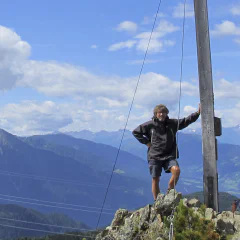
Last month my father Klaus Damian died much too young and rather unexpected. He was a hero to me, like every father should be. But he made it especially easy. When he retired he was the Head of the Astronauts Training Division at the EAC (European Astronaut Centre) of the ESA (European Space Agency). As far as I can remember he always worked with satellites and spacecrafts. He travelled the world to go diving with astronauts in the Caribbean, do zero gravity flights, to see rockets or spaceships take off from all continents. I always remember the map of the world he had on his wall, which had a pin for every trip and they were everywhere. The thing is that you don't realize this as a kid, you get used to the exotic food that you get to know. You get bored of meeting yet another astronauts (except maybe the Russians, they are fun). You forget where you put all the autographs and ESA and NASA stickers and patches. As a teenager you just expect every dad to be like that. So he had a pretty busy life I would say, but when he retired he really started living it to the full. He travelled even more, whenever I tried to call him he was somewhere in the desert in a cave, on top of a mountain in South America, hiking the Camino de Santiago, climbing at Mount Everest Base Camp, sitting on his or some other boat. In 2011 he, my brother, my sister and me did a trip to Vietnam and Cambodia and I must confess I had a bit of trouble keeping up with him. He didn't care if we slept in a luxury hotel, on a boat, in a bus or spent 24 hours in a train, he was always enjoying himself. I have no idea how he found the time, but he also learned to sing, write stories, play the stock market, automate the house (so nobody knows how things work now), dive, paint, run marathons, cycle and all kind of other things. We didn't really talk to much, because of the distance, but also because we both are not really into small-talk. If one of us called the other one we always expected the worst, because why else would you call? He didn't call this time. I hope he doesn't expect us children to achieve what he did, because frankly, he made it a bit difficult by setting the goals so high. But without him I wouldn't be where I am now. I wouldn't have discovered the fun of science and computers so early. I might not have been so open to move to different countries and try new things. I will try to live my life to the full too though, because what else is there? I will miss him.

July 5, 2013 · 3 min · Christof Damian
A Code Review and Continuous Integration Workflow

A Code Review and Continuous Integration Workflow

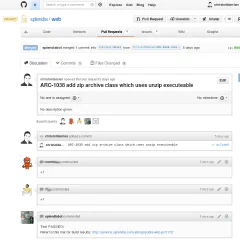
As hopefully most people working on software projects nowadays we are writing unit tests and do code reviews. Work-flow at Splendia As our project is a large PHP site we are using PHPUnit for unit testing and various static code checking tools (checkstyle, phpmd, pdepend, phpcpd) to verify the quality of our code. All of these are run on our integration branch, whenever a new feature is integrated. Before this can happen the code will be reviewed by other people in the team and only if there is a consensus it will be merged into the integration branch. For the code reviews we are using the pull request system of github. It works very similar to other code review tools, you see a diff view of the changes and are able to add comments to discuss the code. In these comments we are using a convention of "+1", "-1" and "[B]" to give the pull request a thumbs up, down or mark it as blocked because a critical bug was found. Anyone in the team has a vote and is allowed to discuss any request. In addition to this the unit tests and some smoke tests will be run on the code of the pull request to avoid merging broken builds. Only if the tests are successful, there are three positive votes in total and no blocker the request will be merged. In the beginning all of this was done manually. Developers had to run the tests before the created the pull request and only senior developers had the right to merge a pull request. Every couple of hours they would check the list of pull requests and verify that they had enough votes. It was a distraction and also prone to mistakes. What gave us a big push in productivity was the introduction of two tools to the work-flow. ghprb First the GitHub pull request builder plugin, which enables Jenkins to automatically start a job for each pull request. It has additional features, like starting another build if more commits are added or recognising comments that instruct it to retest or white-list people who are allowed to create builds. It is similar to the pull request feature of Travis-CI only with the full possibilities of Jenkins to your disposal. With this we are testing every pull request before it gets merged. We also run a limited set of static code analysis, because we want to keep this build fast to give quick feedback. Currently it takes around seven minutes. PullRequester / plus-pull The second tool is a simple script which was written by one of our developers and it was called PullRequester. It runs as a cron job and checks whether the pull requests satisfy the +1 and successful test rules. If all is OK it automatically merges it. I have reimplemented this script to make it possible to publish it. You can find it under the name plus-pull on github. I have added some more features to make it also useful for open source projects. Final Words Even though these tools are not magic the increase of our productivity was visible. I account this mostly to way it enabled asynchronous working. No developer has to wait for a senior developer or poke someone to merge his code. As long as he can find three people who agree it will be merged automatically. And as everyone is interested in reviews themselves they tend to happen quickly. In the screen-shot you can see how this works in practice.

May 18, 2013 · 3 min · Christof Damian
Splendia

Splendia

I must admit that this post comes a bit late. As I have mentioned before, I have left Softonic last year. The main reason was that it was too difficult to change anything there and nobody seemed to know what to do about it. This might have changed by know. After Softonic I started at Splendia, where I am still at. Splendia is a hotel booking website focusing on luxury hotels. The company is much smaller than Softonic in every respect. What drew me in was that they replaced nearly the whole IT team and replaced it with a much more agile team using technologies and methodologies that are industry standards in most PHP companies. The team is also always open for changes to improve the speed of development. When we arrived the state of the code was pretty bad. How bad? Well, there were zero unit tests at the beginning of 2012 for example. By now we have a growing test suite, continuously run through Jenkins. We use github for code reviews, vagrant for workspace virtual machines, cucumber for functional tests, puppet for configuration management and composer to pull in various dependencies including symfony components, doctrine and pear libraries. I will post some more about how we use these in the future. Other nice perks: the computers are nice with two big screens, you get to install your choice OS as long as it runs vagrant. The office is located in the centre of Barcelona, which gives a better choice of restaurants and shops. I can also park my bike in the office, which allows me to commute every day now (more about this later too). There are some things I miss about Softonic though (besides the people there): the pretty office, Spanish classes, free coffee, snacks and the cafeteria for my tea time. Compared to Softonic the office hours at Splendia are also very rigid, which is annoying. Well, hopefully more soon…

February 4, 2013 · 2 min · Christof Damian
Leaving Softonic

Leaving Softonic

moving on Pretty much exactly two years ago I started working for Softonic. I changed from the rather small opus5 to what has been the largest company I have worked for so far. Working in a company of about 250 people with a development team of around 80 people is certainly a different beast. I learned a lot of things especially regarding scrum management and web technologies. I also learned that it is very difficult to change things once something big like this is in motion. Size also brings nice things, Softonic offers a lot of "google-style" perks, like massages, conference trips, insurance, free fruits, sweets and soft drinks, a very nice office with chill-out room and great views. If you are interested have a look at: careers.softonic.com. It also means that you will always find someone interesting to talk to. But now it is time to move on. I am joining a smaller company with a new team, that I will write about in another post. I will stay in Barcelona though. I want to thank everyone I worked with at Softonic, especially the brilliant SD team, SEO, the leads, the UK content team (for tea time entertainment) and everyone I chatted to in these years.

April 18, 2012 · 1 min · Christof Damian

2012 New Year's Resolutions

It is that time of the year again where I make up stuff to ignore for the following twelve months. Last year I didn’t do it, but this year I will give it another try. I has been pointed out that these kind of resolutions doesn’t really fit into the agile way of making decisions that I do subscribe to in my professional life. I will again try to make follow up posts to check how I am doing during the year and possibly adjust the goals. So here we go. No Screen Day – don’t spend any time in front of a screen or phone for one day a week. This can’t be avoided for work, but everything else is forbidden. I am going to start with a low use day, like Tuesdays and then increase it to a day with more free time like Fridays or possibly two weekdays. Sort out Fedora – I am behind with my work on Fedora packages. This has to do with a lack of time, but also with the direction Fedora is taking, which has killed my motivation a bit. First I will catch up with all the work and then decide if I give up on maintaining the packages and switch to CentOS and let other people do the work. If I give up on Fedora there are other open source project where I could invest more time. Cook new stuff – I love cooking, but often I just rehash old recipes or do one of these “whatever is in the fridge” meals. So plan for this year: pick a new recipe every week and cook it on the weekend. Now you are probably wondering where the usual stuff is. You know, the bits about weight and sports. I see those as a given anyway. I will continue to do more mountain biking and running and eat well enough to not end on the very lardy side. I will hopefully also progress on my career without having to do major changes. As these are pretty easy goals I might add harder ones or follow Cutts example in his quest to do a new thing every month and stay with it if it turns out to be nice. btw: I shouldn’t have told you this. 

January 2, 2012 · 2 min · Christof Damian